
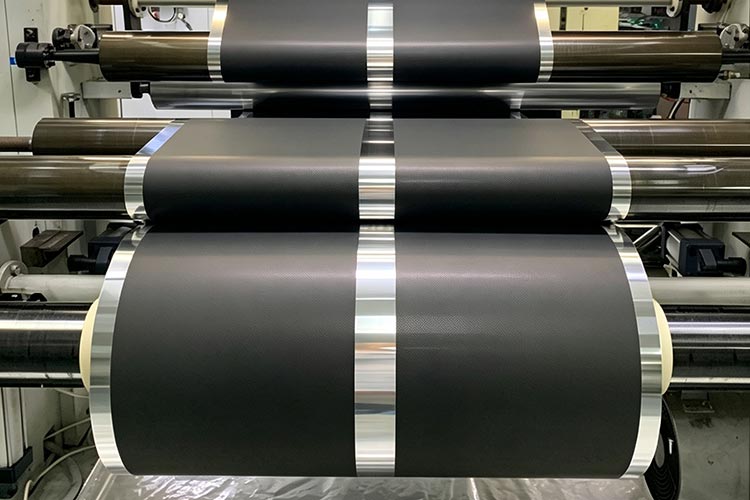
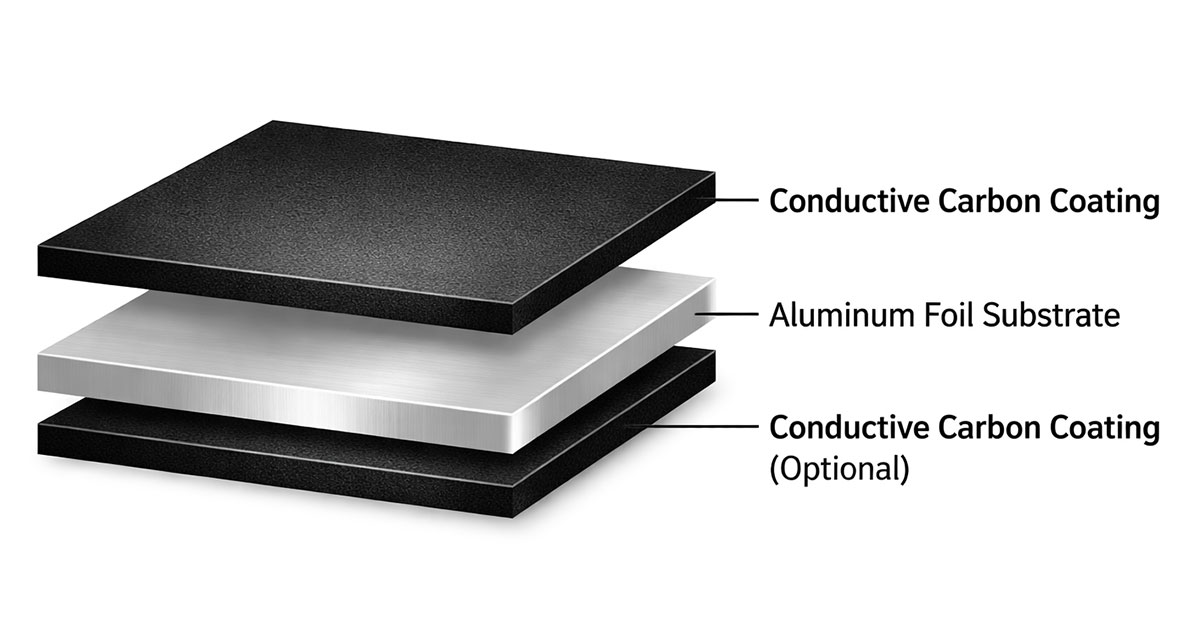
Carbon coated aluminum foil, also known as conductive coated aluminum foil, is a functional composite material consisting of high-purity rolled aluminum foil (typically with a thickness below 50 μm) uniformly coated on one or both sides with a conductive layer. The conductive coating is formulated using advanced materials such as carbon nanotubes (CNTs), graphene, conductive carbon black, conductive graphite, and specialized binders. This engineered structure significantly enhances the electrical and interfacial performance of the aluminum foil.
Description
Structure
Product Features
- Excellent electrochemical stability under high voltage conditions.
- Strong resistance to long-term electrolyte corrosion and immersion.
- Superior surface contact performance for active material adhesion.
- Low interfacial resistance and high conductivity.
- Ability to withstand mechanical stress and structural degradation during long-term cycling.
Specifications
| Item | Typical Range |
|---|---|
| Base Foil Thickness | 10 – 20 µm |
| Carbon Coating Thickness | 1 – 3 µm (per side) |
| Total Thickness | 12 – 25 µm |
| Coating Type | Single-side / Double-side |
| Surface Resistance | ≤ 50 mΩ |
| Adhesion Strength | High (customizable) |
| Width | 100 – 1300 mm |
| Alloy | 1235 / 1060 / 1070 |
| Temper | O |
Applications
- Lithium-ion Batteries
Used in EV batteries, energy storage systems, consumer electronics.
- Supercapacitors
Improves conductivity and charge/discharge efficiency.
- Energy Storage Systems (ESS)
Enhances long-term cycling stability.
- Power Batteries (EV/HEV)
Suitable for high-performance and high-power applications.