
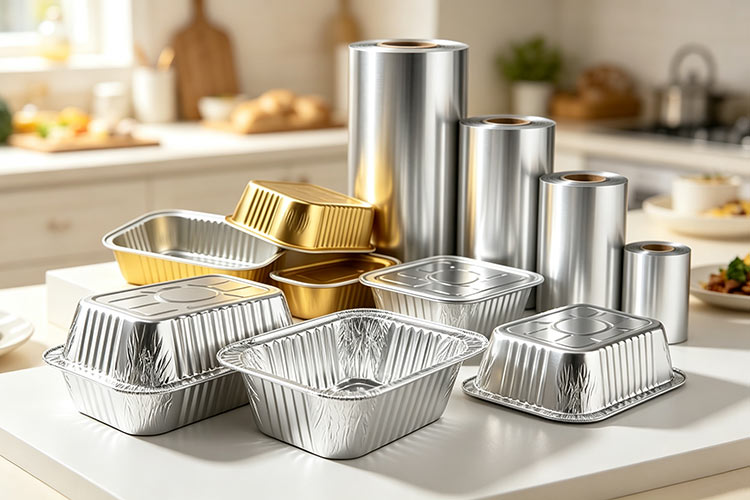
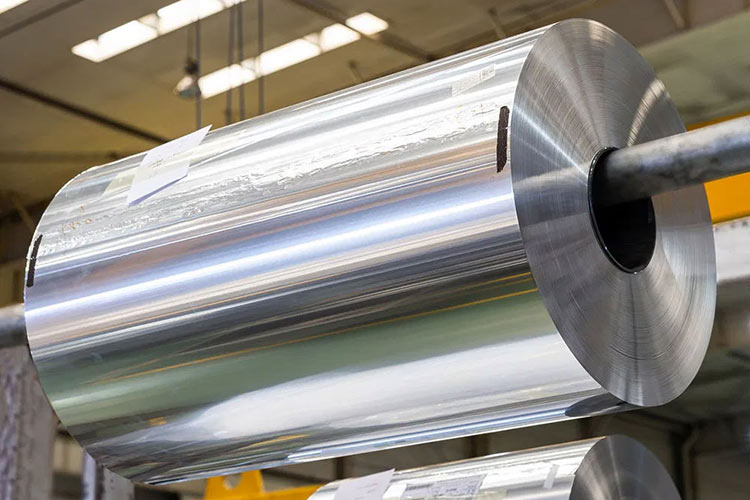
Both 3003 and 3004 container foils (for aluminum foil meal boxes/food containers) belong to the 3-series anti-rust aluminum alloy family. Their core differences originate from the addition of magnesium, with specific distinctions in food container manufacturing scenarios as follows:
1. Core Chemical Composition
| Alloy Grade | Key Alloying Elements (Mass Fraction) | Alloy System |
|---|---|---|
| 3003 | Mn: 1.0~1.6%, no magnesium added | Aluminum-manganese alloy (classic anti-rust aluminum) |
| 3004 | Mn: 1.0~1.6% + Mg: 0.8~1.3% | Aluminum-manganese-magnesium alloy (strengthened version of 3003) |
The addition of magnesium is the root cause of performance differences between the two alloys.
2. Key Performance Differences (O temper/soft deepdrawing state, standard for container foil)
| Performance Metric | 3003 Container Foil | 3004 Container Foil |
|---|---|---|
| Tensile Strength | 110~150 MPa | 140~190 MPa (~20% higher than 3003) |
| Elongation | 15~25% (higher) | ≥12% (slightly lower) |
| Stiffness & Deformation Resistance | Moderate; prone to sagging and edge curling when stacked heavily after filling | Excellent; can be stacked 10 layers high when full without deformation, with crisp, rigid edges |
| Formability | Resistant to cracking during complex deep drawing and multi-compartment forming | Higher yield rate (up to 98.5%) for simple structure stamping; prone to cracking at partition walls during multi-compartment stamping |
| Corrosion Resistance | Good, suitable for contact with common foods | Superior; better resistance to acidic and high-salt foods, ideal for heavily seasoned takeout and baking scenarios |
| Temperature Resistance | Withstands -20 ℃ freezing to 220 ℃ baking | Same temperature range, with better shape retention under high-temperature baking |
3. Production Process Differences
- 3003: Compatible with both twin-roll casting and hot rolling processes; twin-roll casting offers lower cost and higher production efficiency.
- 3004: Only compatible with hot rolling processes; the industry currently predominantly uses recycled aluminum for production, which better aligns with low-carbon and environmental protection requirements.
4. Meal Container Application Differences (Most Critical Distinction)
| Container Type | 3003 Container Foil | 3004 Container Foil |
|---|---|---|
| Single-compartment containers (no partitions, e.g., barbecue trays, clay pot rice boxes, baking pans, large-capacity takeout boxes) | Usable but less cost-effective, largely phased out | Industry standard choice ; high strength and high stamping yield rate; nearly all domestic single-compartment meal boxes now use 3004 |
| Multi-compartment/ divided containers (2/3/4-compartment boxes, e.g., airline meals, divided takeout boxes) | Primary material ; high elongation prevents cracking at partition walls during stamping; still the preferred choice for export-grade high-end divided containers | Not suitable; prone to cracking at partition walls during stamping, cannot produce multi-compartment structures |
| Wrinkle-free/coated containers (high-end takeout boxes, air fryer liners) | Usable | Better compatibility; superior surface quality and stable coating adhesion |
5. Cost & Market Trends
- In the early stage, 3003 was the mainstream meal box material due to the lower cost of the twin-roll casting process. However, its cost advantage has diminished as manganese prices have risen in recent years. 3004 now offers better overall cost performance thanks to its compatibility with recycled aluminum production.
- Aligned with environmental recycling trends, 3004’s market share has grown year by year, becoming the absolute mainstream material for single-compartment meal boxes. 3003 only retains a presence in the niche multi-compartment container segment.
6. Common Features
Both alloys meet FDA, EU, and Chinese national food contact material safety standards: they are non-toxic, tasteless, safe for direct food contact, and fully recyclable for infinite reuse.