
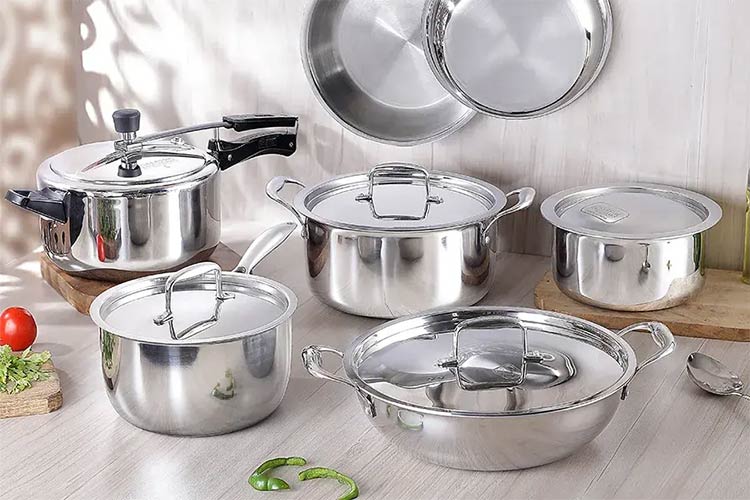
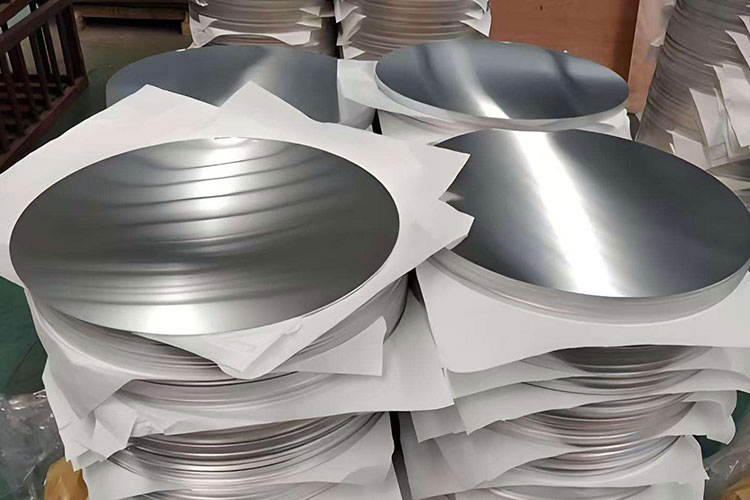
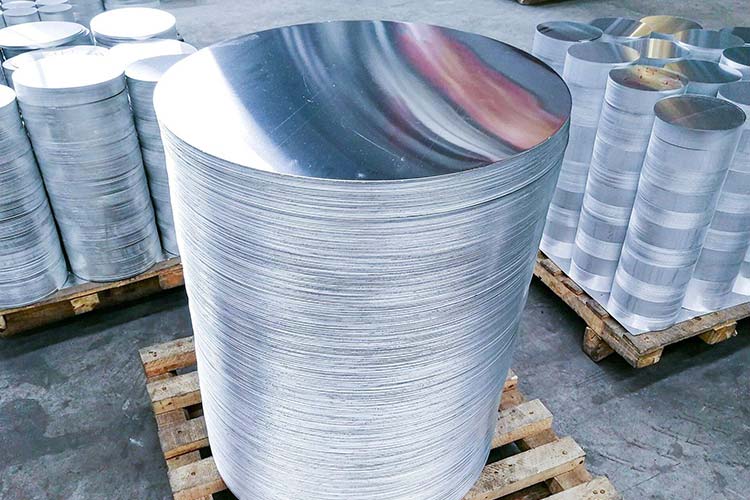
Aluminum circles, due to their excellent thermal conductivity, lightweight, corrosion resistance, and outstanding formability, are suitable for deep drawing, spinning, and stamping processes commonly used in cookware manufacturing. This results in the production of a variety of kitchen utensils (such as frying pans, saucepans, pressure cookers, and stockpots).
Description
Aluminum circles are typically made from high-quality aluminum coils through precision cutting or stamping processes, ensuring smooth edges, uniform thickness, and excellent surface quality.
Typical Applications
- Frying pans.
- Sauce pans.
- Cooking pots.
- Pressure cookers.
- Rice cooker inner pots.
- Non-stick cookware.
- Kitchen utensils.
- Aluminum lids.
Typical Specifications
| Item | Specification |
|---|---|
| Alloy | 1050, 1060, 1100, 3003, 5052 |
| Temper | O, H12, H14 |
| Thickness | 0.4 – 6.0 mm |
| Diameter | 80 – 1200 mm |
| Surface | Mill finish, anodized, coated |
| Edge | Smooth edge, burr-free |
Manufacturing & Quality Advantages
- Food-Grade Aluminum Material
Cookware aluminum circles are produced using high-purity aluminum that complies with food contact safety standards, ensuring safe use in kitchen utensils and cooking equipment.
- International Quality Compliance
The products can meet various international standards and certifications such as FDA, LFGB, and RoHS, making them suitable for export to global cookware markets.
- Stable Mechanical Performance
Strict control of alloy composition, rolling processes, and annealing treatments ensures stable hardness, excellent elongation, and consistent forming performance, which is critical for deep drawing cookware.
- Advanced Production Technology
Modern automated production lines and precision blanking equipment ensure high dimensional accuracy, smooth edges, and minimal material waste.