
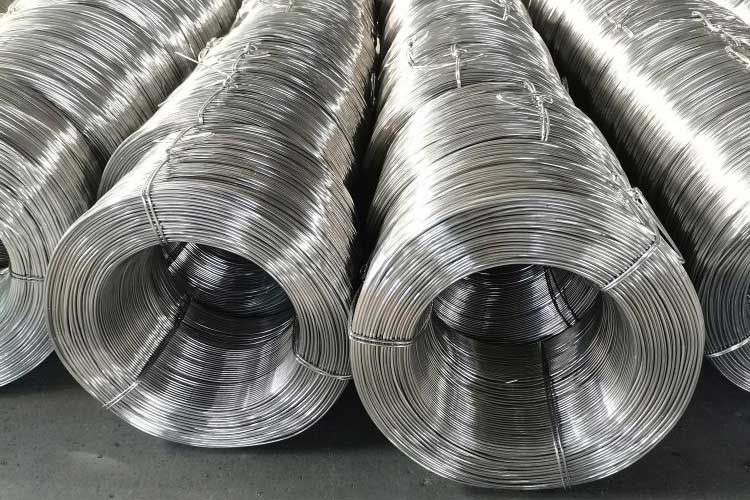

Aluminum alloy wire can be used to make filter bag cages, but it is only limited to working conditions of normal temperature, low corrosion and weight-sensitive requirements; it is not recommended for scenarios of high temperature, strong corrosion and pulse dust cleaning.
Advantages
- Extremely lightweight
Approximately 1/3 the weight of carbon steel, making installation and maintenance easier and suitable for mobile equipment or lightweight designs.
- Decent corrosion resistance
Resistant to weak corrosion after anodizing, not prone to rust, and eliminates the risk of rust contamination of the filter bag.
- Smooth surface
Burr-free, preventing filter bag damage.
- Conductive/explosion-proof
The aluminum alloy is conductive, suitable for anti-static and explosion-proof applications.
Disadvantages
- Low Strength
Hardness and tensile strength are lower than carbon steel/stainless steel; prone to deformation and weld detachment during pulse cleaning.
- Temperature Resistance
Long-term resistance is ≤200℃, far exceeding which it softens and deforms easily; significantly lower than carbon steel (≤200℃) and stainless steel (≤450℃).
- Difficult Welding
Aluminum alloy welding requires specialized processes, resulting in high costs and a tendency for incomplete welds.
- High Cost
Wire and processing costs are higher than for ordinary carbon steel.
Applicable and Inapplicable Scenarios
Suitable
- Normal temperature (<100℃), dry, mildly corrosive environments.
- Mobile dust collectors, automotive painting, food and pharmaceutical (no metal contamination).
- Low pressure, low pulse frequency operating conditions.
Not Suitable
- High-temperature flue gas (>120℃): such as cement kilns, waste incineration, coking plants.
- Strongly corrosive: high humidity, acid and alkali, chlorine/fluorine-containing flue gas.
- High pressure/high frequency pulse: prone to deformation, breakage, and bag abrasion.
- Long bags (>3m): insufficient rigidity, prone to bending and collapse.
Comparison of Mainstream Materials
| Material | Temperature Resistance | Strength | Corrosion Resistance | Weight | Cost |
|---|---|---|---|---|---|
| Aluminum Alloy | ≤120℃ | Medium | Good for weak corrosion | Lightest | Medium-High |
| Galvanized Carbon Steel | ≤200℃ | High | Average | Heavy | Low |
| 304 Stainless Steel | ≤250℃ | High | Good | Heavy | Medium |
| 316L Stainless Steel | ≤450℃ | High | Excellent | Heavy | High |