
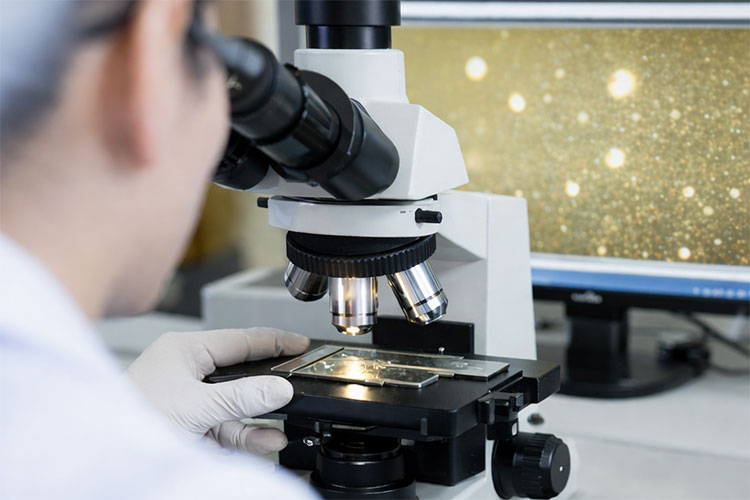
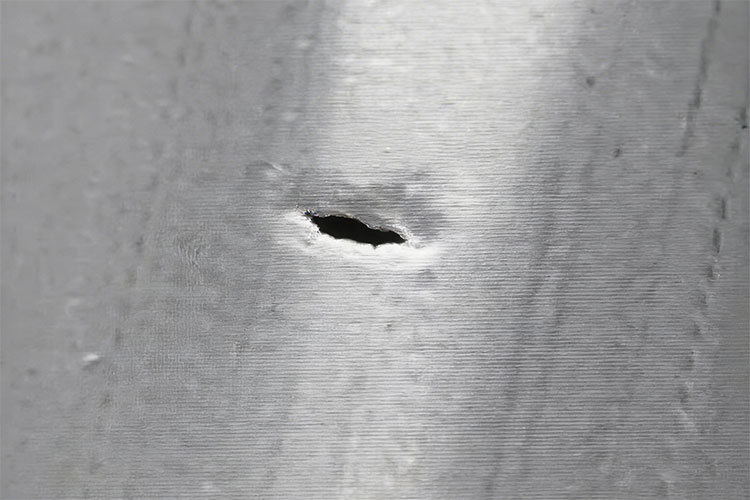
Definition and Characteristics of Pinholes
Pinholes refer to irregular micro-holes visible on the surface of aluminum foil when observed against light. They are one of the most critical quality indicators of aluminum foil, especially for high-end applications such as food packaging, pharmaceutical foil, and electronic materials.
As the foil thickness decreases, the continuity of the material is reduced, and the number of pinholes tends to increase significantly. Therefore, pinholes are considered one of the most typical and critical defects in ultra-thin aluminum foil.
Since pinholes are often formed by the propagation, tearing, or detachment of internal defects during rolling, it is difficult to directly trace them back to their original sources. In general, pinholes are closely related to gas content, inclusions, intermetallic compounds, segregation, and processing conditions.
The causes can be analyzed from two main aspects: slab (stock) quality and production process.
Effect of Slab Quality on Pinholes
01 Alloy Purity and Composition Control
The chemical composition of the slab directly affects its plasticity and workability:
- Too low purity: High impurity content reduces ductility, making the material prone to microcracks during rolling, which may develop into pinholes.
- Too high purity: The material becomes too soft, leading to roll sticking, increased friction, and surface damage that can result in pinholes.
Therefore, proper alloy composition control is essential.
02 Internal Structural Defects
Metallurgical defects inside the slab are major sources of pinholes, including:
- Segregation (macro and micro).
- Microporosity and gas bubbles (hydrogen).
- Non-metallic inclusions (oxides, slags).
- Oxide films.
- Cracks and delamination.
During rolling, these discontinuities cannot deform uniformly, leading to stress concentration, rupture, or particle pull-out, ultimately forming pinholes.
03 Coarse Second-Phase Particles (e.g., FeAl₃)
The presence of coarse intermetallic particles such as FeAl₃ can significantly affect foil quality:
- These hard particles deform inconsistently with the matrix.
- Microcracks tend to form at the interfaces.
- As thickness decreases, cracks propagate and evolve into pinholes.
This tendency becomes more pronounced with increasing work hardening.
04 Surface Quality of the Slab
Surface defects in the slab strongly influence the final foil quality, including:
- Scratches and abrasions.
- Corrosion spots.
- Embedded metallic or non-metallic particles.
- Indentation marks.
- Dendritic structures.
During rolling, these defects are progressively magnified as thickness decreases, eventually forming pinholes or even perforations.
Grain Structure and Uniformity
- Coarse grains or non-uniform microstructure (especially with twins).
- Poor deformation compatibility.
- Increased likelihood of localized cracking.
These factors contribute to pinhole formation during rolling.
Effect of Production Process on Pinholes
01 Rolling Parameters
Key rolling parameters have a direct impact on pinhole formation:
- Excessive rolling speed: Causes uneven deformation and tearing.
- Excessive tension: Increases tensile stress, leading to rupture.
- Improper reduction schedule: Causes stress concentration.
Optimizing rolling speed, tension, and reduction ratio is essential to minimize pinholes.
02 Rolling Oil Management
Rolling oil plays both lubrication and cleaning roles:
- Contaminated oil: Solid particles can scratch the surface and cause pinholes.
- Excessive viscosity: Leads to uneven lubrication and increased roughness.
- Insufficient oil supply: Cannot effectively remove debris.
- High oil temperature: Reduces oil film thickness and lubrication efficiency.
Maintaining clean, stable, and properly controlled rolling oil is critical.
03 Roll Condition
Roll quality directly determines foil surface quality:
- Excessive roll crown leads to uneven pressure distribution.
- High surface roughness causes surface damage.
- Roll defects (wear, dents) can transfer to the foil surface.
High-precision rolls and proper maintenance are essential.
04 Production Environment
External contamination also plays a role:
- Dust in the air
- Aluminum debris and other particles
These contaminants can be pressed into the foil surface during rolling, leading to pinholes.
Conclusion and Optimization Strategies
With the advancement of modern aluminum foil production:
- Rolling oil systems have become cleaner.
- Production environments are better controlled.
- Roll surface quality has significantly improved.
As a result, slab quality has become the dominant factor influencing pinhole defects.
Key measures to reduce pinholes
- Reducing hydrogen content in molten aluminum.
- Improving melt cleanliness and minimizing inclusions.
- Optimizing alloy composition to reduce coarse intermetallics.
- Enhancing casting and heat treatment processes.
- Refining microstructure and phase distribution.
- Precisely controlling rolling parameters such as speed, tension, and reduction.
By combining source control and process optimization, the pinhole rate in aluminum foil can be effectively reduced, ensuring higher product quality and consistency.