


Why is aluminum foil annealed?
The core process of aluminum foil production is cold rolling, which involves pressing aluminum blanks to the required thickness through multiple rounds of high-strength rolling. However, the cold rolling process causes “work hardening” of the aluminum foil — the internal crystal lattice of the metal is squeezed and distorted, making the aluminum foil hard and brittle, easy to break when folded or pulled, and unable to meet the subsequent use and processing requirements. The core purpose of annealing is to solve this problem, transforming the aluminum foil from a “hard and brittle semi-finished product” into a “soft and usable finished product”.
- Eliminate work hardening
Through heating, heat preservation and slow cooling, the distorted crystal grains are rearranged and restored to regularity, reducing the hardness of the aluminum foil, improving its toughness and avoiding breakage.
- Improve ductility and formability
After annealing, the aluminum foil becomes soft and tough, which can be easily bent, wrapped and stamped, adapting to various scenarios such as food packaging, lunch boxes and capacitor foil without edge cracking or breakage.
- Remove internal stress and stabilize dimensions
After cold rolling, huge internal stress remains in the aluminum foil, which is prone to curling, edge warping, slitting wrinkles and other problems. Annealing can release internal stress, keeping the aluminum foil flat and dimensionally stable.
- Optimize performance to adapt to uses
According to different needs, annealing can improve the surface flatness of aluminum foil, reduce pinholes, adjust conductivity (such as aluminum foil for electronic use), and distinguish different states such as full softness and semi-hardness to adapt to different scenarios such as household and industrial use.
Annealing process
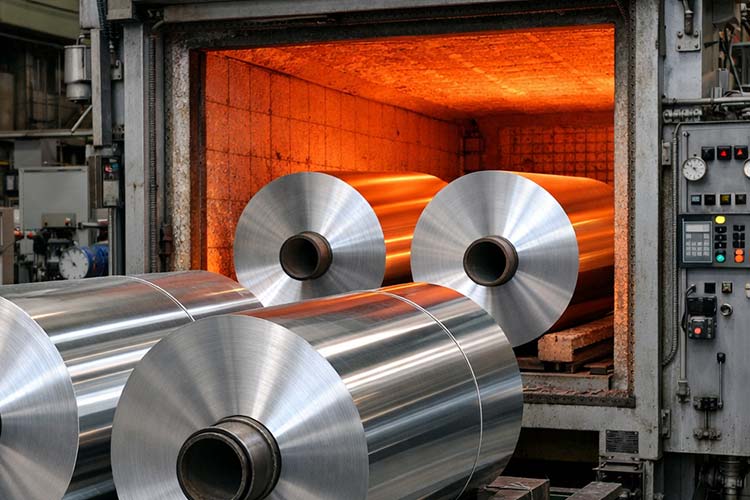
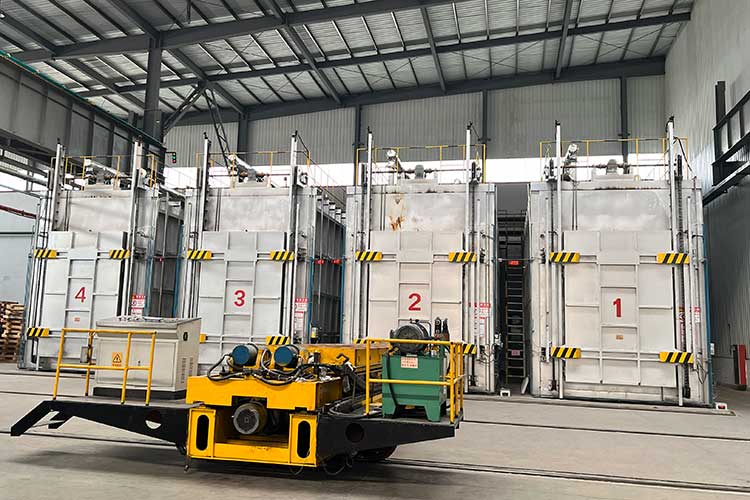
The aluminum foil annealing process refers to a series of heat treatment processes in which the cold-rolled hard aluminum foil is placed in a special annealing furnace for heating, heat preservation and slow cooling according to the preset temperature, holding time and cooling rate. Its essence is to repair the internal crystal lattice defects of the aluminum foil and adjust its physical properties through thermal action.
Key process parameters (commonly used industry standards)
- Heating temperature: Usually between 300-400℃, which needs to be accurately adjusted according to the thickness, material and use of the aluminum foil (excessively high temperature may lead to excessive grain size and surface oxidation, while excessively low temperature cannot completely eliminate work hardening).
- Holding time: Generally 2-6 hours, the purpose is to fully restore the internal crystal grains of the aluminum foil and completely release the stress. The thicker the thickness, the longer the holding time usually is.
- Cooling rate: Slow cooling (natural cooling or gradient cooling) is required. Rapid cooling will generate internal stress again, leading to annealing failure and failure to achieve the softening effect.
Common types
According to different uses, it is divided into full annealing (used for food packaging and household aluminum foil, fully softened with the best toughness) and incomplete annealing (used for some industrial aluminum foil, retaining a certain hardness and balancing toughness and strength).