


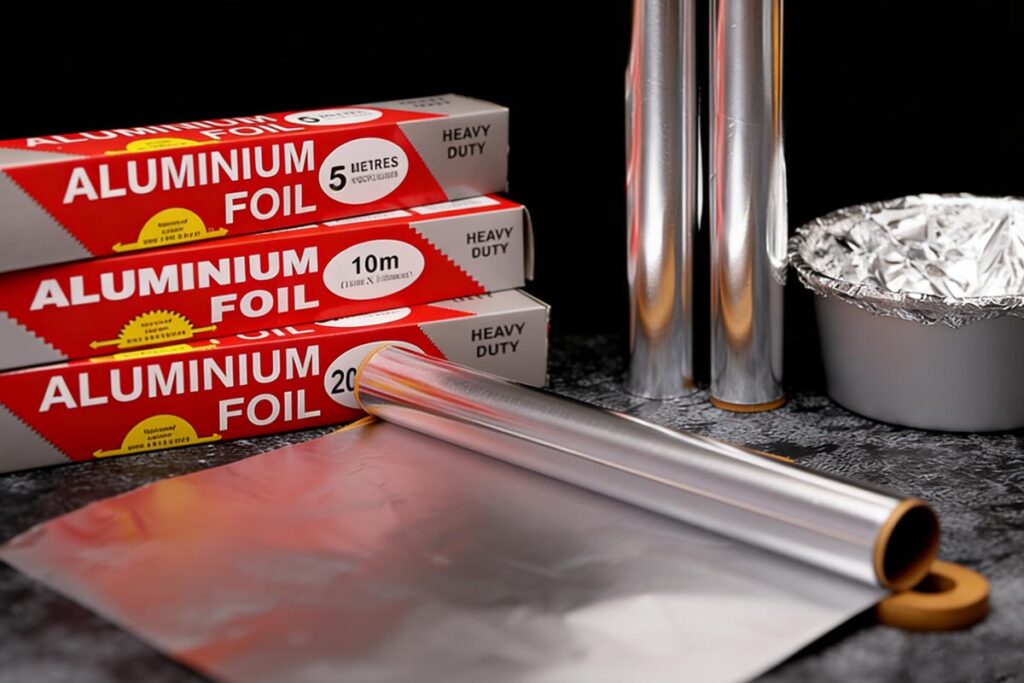
Aluminum foil is widely used in both household and industrial scenarios due to its lightweight nature, excellent ductility, and superior barrier properties. However, significant disparities exist between the two types in terms of strength, thickness, and applications—rooted in their distinct performance requirements: household foil prioritizes convenience and safety, while industrial foil emphasizes durability and functionality. This article breaks down the core differences and underlying reasons across three key dimensions, with precise parameters and scenario-based examples.
1. Thickness Difference: Thin for Households, Thick for Industry (3–50x Variation)
Thickness is the most intuitive distinction, directly determining strength and application scope. The thickness ranges of household and industrial aluminum foil barely overlap, with industrial foil being 3 to 50 times thicker overall. Detailed parameters are as follows:
- Household Aluminum Foil: Thickness ranges from 0.01 to 0.06 mm (10–60 μm), with the most common daily-use specifications at 10–20 μm. Heavy-duty household foil only reaches 25–30 μm, with a maximum thickness of 40 μm. This thickness balances lightness and ease of folding with basic wrapping and leak-proof needs, while keeping costs low for one-time or short-term use. Intuitively, it is soft and pliable—easily torn by hand, highly conformable, and able to wrap irregularly shaped food or containers effortlessly.
- Industrial Aluminum Foil: Boasts a much wider thickness range, from 0.02 to 0.3 mm (20–300 μm) for standard applications. Specialized scenarios (e.g., aerospace, high-voltage electronics) can require thicknesses exceeding 0.5 mm, while precision industrial foil (for capacitors and electronic components) can be as thin as 6 μm. In the automotive and construction industries, the most commonly used thickness is 0.1–0.2 mm (5–10 times thicker than standard household foil). For high-temperature and shielding applications, thicknesses of 0.2–0.3 mm are typical (3–30 times thicker than household foil). Industrial foil also features stricter thickness tolerance control: premium scenarios like aerospace demand tolerances within 0.001 mm, far exceeding the 0.005 mm tolerance of household foil.
Core Summary: Under normal circumstances, industrial aluminum foil is 3–50 times thicker than household foil. A common comparison (15 μm household vs. 0.1 mm industrial) shows a 6.7x difference; in extreme cases (10 μm household vs. 0.5 mm industrial), the gap can reach 50x. This difference stems from functional priorities: households value “convenience” (thinness for ease of use), while industry prioritizes “durability” (thickness to withstand harsh conditions like high temperatures, friction, and pressure).
2. Strength Difference: Soft for Households, Rigid for Industry (2–7x Tensile Strength Variation)
Strength disparities arise from both thickness and alloy composition. Industrial aluminum foil exhibits 2 to 7 times higher tensile strength and hardness than household foil, with the following specific performance metrics:
- Household Aluminum Foil: Primarily made from pure aluminum (AA-1000 series) and fully annealed during production to maximize softness and ductility—ideal for folding and shaping but extremely low in strength. Its tensile strength typically ranges from 80 to 130 MPa. It is so soft that a light fingernail scratch leaves a mark, and it can be easily crumpled, stretched, or torn by hand. Unable to withstand friction, punctures, or repeated use, it only meets basic needs like food wrapping and insulation, with no load-bearing or protective capabilities.
- Industrial Aluminum Foil: Utilizes aluminum alloys (predominantly AA-8000 series, with some 3000 series variants) reinforced with manganese, silicon, and other elements to enhance strength and toughness. Specialized processes such as cold working and aging treatment further optimize its mechanical properties. Tensile strength varies by application: General industrial scenarios (packaging, insulation): 180–300 MPa (2–2.3x that of household foil). High-end scenarios (aerospace, automotive structural parts): 400–600 MPa (3–7x that of household foil). Industrial foil offers high hardness, excellent puncture and wear resistance, and can endure repeated folding, external impact, and high temperatures without damage—making it suitable for complex industrial processes (e.g., welding, shielding, insulation).
Additional Note: Ductility differs inversely between the two types: household foil has exceptional ductility (stretchable to several times its original length), while industrial foil, due to alloying elements, has slightly reduced ductility but significantly improved toughness (resistance to breakage). Industrial foil also outperforms household foil in heat resistance: it can withstand temperatures above 371°C (some up to 700°F+), whereas household foil may degrade at around 232°C (450°F), precluding its use in high-temperature industrial environments.
3. Application Difference: Food-Centric vs. Industrial-Grade (No Overlap)
Differences in thickness and strength result in completely distinct application scenarios: household foil is focused on “light-duty food-related use,” while industrial foil serves “functional industrial applications,” with no significant overlap.
(1) Household Aluminum Foil: Single-Scenario Focus on Convenience and Safety
Core applications revolve around food storage, cooking, and insulation, emphasizing disposability, convenience, and food safety—with no industrial utility:
- Food Packaging and Preservation: Wrapping meat, vegetables, fruits, and other ingredients to isolate air, moisture, and odors, preventing oxidation and cross-contamination in refrigerators. It can be directly used for freezing or refrigeration, preserving the shape and moisture of ingredients.
- Cooking and Baking: Suitable for ovens and steamers—wrapping sweet potatoes, potatoes, fish, and other foods ensures even heating, prevents charring, and stops sauce leakage. It also prevents food from sticking to pans during cooking.
- Auxiliary Household Uses: Beyond food applications, it can be crumpled into balls for cleaning burnt cookware and removing grease, restoring shine to silverware, reducing static in dryers, and enhancing lighting brightness. These uses leverage its basic softness, thermal conductivity, and electrical conductivity.
The primary requirement for household foil is food safety compliance—it must be odorless, leak-proof, free of harmful impurities, and safe for direct food contact, with low costs suitable for one-time disposal.
(2) Industrial Aluminum Foil: Multi-Domain Coverage Focused on Function and Durability
Core applications address industrial “functional needs” (e.g., shielding, insulation, thermal management, structural support). Depending on alloy composition and thickness, it spans numerous industries:
- Automotive Industry: Used in heat exchangers (radiators, condensers), air conditioner fins, and lightweight body components. Its lightweight, thermal conductivity, and high strength replace copper foil, reducing vehicle weight and improving fuel efficiency. It also shields automotive wiring harnesses from signal interference.
- Electronics Industry: Applied in electrolytic capacitors (cathode foil, high-voltage foil), EMI/RFI shielding for electronic circuits, and current collectors for lithium-ion batteries (carbon-coated aluminum foil). Its electrical conductivity, barrier properties, and precision ensure the stability of electronic components. It also protects and shields cables from external damage and interference.
- Construction and HVAC: Integrated into thermal insulation materials (e.g., aluminum foil corrugated cardboard, mineral wool boards) and roof insulation/acoustic materials for factories and residential buildings, utilizing its barrier and thermal properties to reduce heat transfer. It is also a key material for air conditioner fins (air conditioner foil), typically 0.1–0.15 mm thick, with a growing trend toward further thinning to improve energy efficiency.
- High-End Specialized Fields: In aerospace, it insulates and shields spacecraft components. In medical and nuclear facilities, it provides radiation shielding. In the chemical industry, it acts as a corrosion-resistant barrier layer. In printing, it serves as a PS plate base for the packaging and printing sector.
- Industrial Packaging: Used to package pharmaceuticals, chemicals, and precision components. Its barrier and puncture resistance extend product shelf life and protect items from environmental factors (e.g., moisture, corrosion).
The primary requirement for industrial aluminum foil is functional compliance—it must meet strict industry standards for mechanical properties, thermal stability, and chemical resistance, with customized specifications for specific high-end scenarios.