


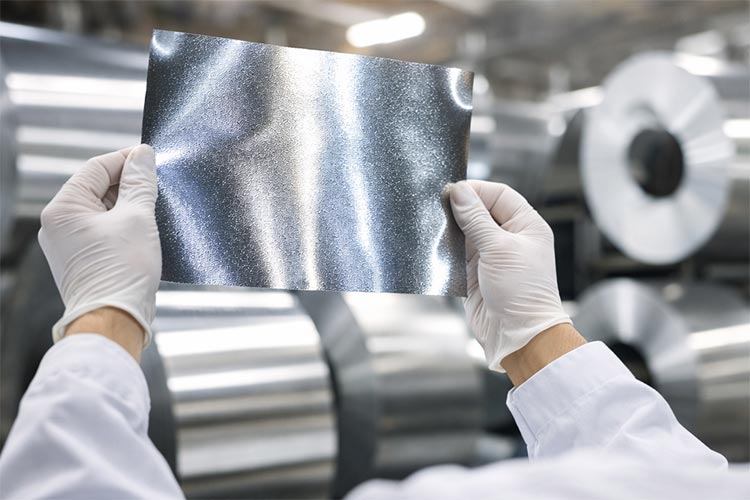
Aluminum foil is an indispensable material in packaging, industrial, and even household applications, valued for its lightweight, barrier properties, and ease of processing. Among the numerous aluminum foil alloys, the 8000 series stands out for its versatility, with 8011 and 8021 being two of the most widely used grades. At first glance, they may seem interchangeable, but subtle differences in their chemical composition, mechanical properties, and performance characteristics make each better suited for specific scenarios. This article breaks down the real differences between 8011 and 8021 aluminum foil, helping you make informed decisions for your application needs.
1. Chemical Composition: The Foundation of Differences
The core distinction between 8011 and 8021 aluminum foil lies in their chemical makeup, particularly the types and proportions of alloying elements. Both belong to the 8000 series (aluminum-lithium alloys with minor additions of other elements), but their elemental compositions diverge significantly, laying the groundwork for their distinct properties.
8011 Aluminum Foil Composition
8011 aluminum foil is characterized by the presence of manganese (Mn) and magnesium (Mg), two elements that enhance its mechanical strength and corrosion resistance. Its typical chemical composition (by weight percentage) is as follows:
- Silicon (Si): 0.50 – 0.90%
- Iron (Fe): 0.60 – 1.00%
- Copper (Cu): ≤ 0.10%
- Manganese (Mn): ≤ 0.20%
- Magnesium (Mg): ≤ 0.05%
- Zinc (Zn): ≤ 0.10%
- Titanium (Ti): ≤ 0.08%
- Other elements (each): ≤ 0.05%; total: ≤ 0.15%
- Aluminum (Al): Balance
The addition of Mn and Mg, though in small amounts, gives 8011 a slight edge in strength and corrosion resistance compared to 8021.
8021 Aluminum Foil Composition
In contrast, 8021 aluminum foil contains no manganese or magnesium. Instead, it has a higher iron content and a notable addition of copper, which contributes to its ductility and formability. Its typical chemical composition (by weight percentage) is:
- Silicon (Si): ≤ 0.15% (or ≤ 0.40% in some specifications)
- Iron (Fe): 1.00 – 1.50%
- Copper (Cu): 1.20 – 1.70%
- Manganese (Mn): ≤ 0.05%
- Magnesium (Mg): ≤ 0.05%
- Zinc (Zn): ≤ 0.10%
- Titanium (Ti): ≤ 0.08%
- Other elements (each): ≤ 0.05%; total: ≤ 0.15%
- Aluminum (Al): Balance
The absence of Mn and Mg, combined with higher Fe and Cu content, makes 8021 more flexible and easier to form than 8011.
2. Mechanical Properties: Strength vs. Ductility
The differing chemical compositions directly translate to distinct mechanical properties, particularly in terms of tensile strength, elongation, and puncture resistance. These properties are critical for determining which foil is suitable for applications that require durability, flexibility, or formability.
Tensile Strength
Tensile strength refers to a material’s ability to resist breaking under tension. Thanks to its Mn and Mg content, 8011 aluminum foil has a moderate tensile strength range of 80 – 110 MPa. This makes it sturdy enough for general-purpose packaging and industrial uses but not overly rigid.
8021 aluminum foil, on the other hand, has a higher tensile strength range of 100 – 140 MPa. The addition of copper enhances its structural integrity, making it more resistant to tearing and breaking during processing and use. This higher strength is particularly valuable for applications like battery soft packaging, where durability is paramount.
Elongation and Formability
Elongation measures a material’s ability to stretch before breaking, a key indicator of formability. Here, 8021 outperforms 8011: 8021 has an elongation rate of 13% – 18%, while 8011 typically ranges from 13% – 15% (depending on temper). This means 8021 can be stretched, bent, and deep-drawn more easily without cracking, making it ideal for complex shapes like blister packs and battery casings.
8011, with its lower elongation, is less suitable for deep-drawing applications but performs well in flat or simple-shaped packaging, where flexibility is required but extreme forming is not.
Puncture and Tear Resistance
8021 aluminum foil also boasts superior puncture and tear resistance compared to 8011. Its higher ductility and mechanical strength make it more resilient to sharp objects and mechanical stress, which is critical for packaging products that need to maintain their integrity, such as pharmaceuticals and lithium-ion batteries. 8011, while sufficiently durable for most general uses, is more prone to puncturing if exposed to sharp edges or heavy pressure.
3. Performance Characteristics: Barrier, Safety, and Processability
Beyond mechanical properties, 8011 and 8021 differ in their barrier capabilities, safety profiles, and processability—factors that further narrow their application scope.
Barrier Properties
Both foils offer excellent barrier properties against moisture, oxygen, light, and odors, making them suitable for packaging. However, 8021 has a slight advantage due to its smoother surface, uniform thickness, and minimal pinholes. This makes it more effective at blocking external contaminants, a critical feature for pharmaceutical and food packaging where product freshness and safety are non-negotiable.
8011 also has good barrier properties but may have slightly more pinholes (depending on production quality), making it better suited for less demanding packaging applications.
Safety and Hygiene
Both 8011 and 8021 are safe for food and pharmaceutical contact, as they are non-toxic, odorless, and meet international safety standards. Both undergo rigorous testing for bacteria, mold, and heavy metals, with heavy metal content not exceeding 0.25 ppm—well below safety limits. 8021, however, is often preferred for high-end pharmaceutical packaging (such as cold-formed blister packs) due to its stricter surface quality controls and lower pinhole rate.
Processability
8011 aluminum foil is easier and more cost-effective to produce in large quantities. Its composition allows for smoother rolling and slitting, making it a popular choice for mass-produced packaging like food wraps, tape foils, and cable foils. It also handles printing and coating well, making it versatile for branded packaging.
8021, while processable, requires more precise manufacturing controls due to its higher copper content. This makes it slightly more expensive to produce, but its superior formability and durability justify the cost for specialized applications. It is also compatible with lamination and heat-sealing processes, making it suitable for flexible packaging and battery soft packs.
4. Application Scenarios: Choosing the Right Foil
The differences in composition, properties, and performance mean 8011 and 8021 are optimized for distinct applications. Understanding these use cases is key to selecting the right foil for your needs.
8011 Aluminum Foil Applications
8011 is the workhorse of the two, valued for its versatility, cost-effectiveness, and balanced properties. Its main applications include:
- General food packaging: Food wraps, takeout containers, milk caps, and瓶盖料 (bottle cap foil).
- Industrial uses: Tape foils, cable foils, and roofing insulation (thanks to its good corrosion resistance and heat reflectivity, which can reach up to 96%).
- Basic pharmaceutical packaging: Backing foils for drug tablets and capsules (where extreme formability is not required).
- Household products: Kitchen foil rolls and simple packaging for consumer goods.
8021 Aluminum Foil Applications
8021 is a high-performance foil, preferred for specialized applications that demand superior formability, strength, and barrier properties. Its main applications include:
- Pharmaceutical packaging: Cold-formed blister packs, PTP (Press-Through Packaging) foils, and tropical foils (where deep-drawing and puncture resistance are critical).
- Battery packaging: Lithium-ion battery soft packs (due to its excellent deep-drawing performance, puncture resistance, and compatibility with electrolyte corrosion).
- High-end food packaging: Complex-shaped food containers, laminated packaging for snacks, and meal box materials (where surface quality and barrier properties are important).
- Flexible packaging: Stand-up pouches, gusseted bags, and laminated tubes (thanks to its good elongation and lamination productivity).
5. Cost Comparison: Value vs. Performance
Cost is another key difference between 8011 and 8021 aluminum foil. 8011 is generally more affordable due to its simpler composition and easier manufacturing process. It is the go-to choice for applications where cost is a primary concern and high-end performance is not necessary.
8021, on the other hand, is slightly more expensive. Its higher copper content and more precise manufacturing requirements increase production costs, but its superior properties (formability, strength, barrier capabilities) make it a cost-effective choice for specialized applications where product integrity and performance are critical. For example, using 8021 in battery soft packs reduces the risk of leakage and damage, ultimately lowering long-term costs.
Which One Should You Choose?
The real difference between 8011 and 8021 aluminum foil boils down to composition-driven properties and application optimization. To summarize:
- Choose 8011 if you need a versatile, cost-effective foil for general packaging, industrial uses, or household applications. It offers balanced strength, corrosion resistance, and processability, making it ideal for mass-produced, non-specialized products.
- Choose 8021 if you require superior formability, strength, and barrier properties for specialized applications like pharmaceutical blister packs, battery soft packs, or high-end food packaging. It may cost more, but its performance ensures product integrity and reliability in demanding scenarios.
In short, 8011 is the practical choice for everyday use, while 8021 is the high-performance option for specialized needs. By understanding their chemical, mechanical, and performance differences, you can select the aluminum foil that best aligns with your application goals, balancing cost, performance, and reliability.