
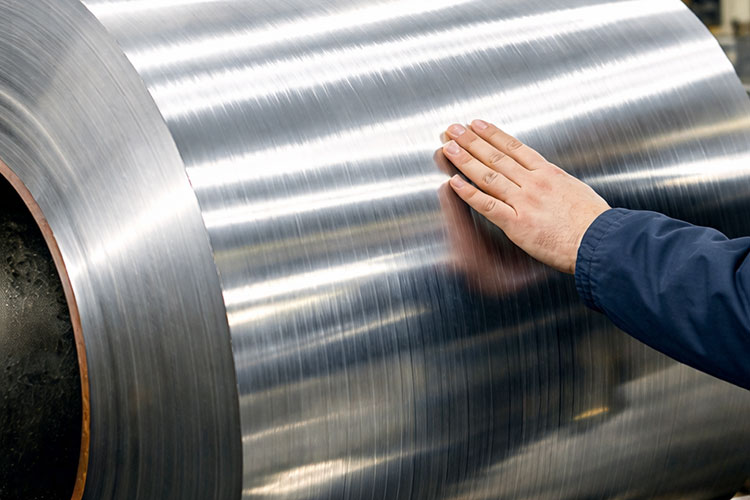
During the rolling of strip into various aluminum foil semi-finished and finished products, as well as during finishing, annealing, slitting, transportation, and packaging processes, certain defects are unavoidable.
These defects mainly originate from two sources:
- Ingot and strip-related defects: Metallurgical defects existing in cast ingots or cast-rolled strips. Some are exposed during casting or hot rolling, while others only appear during subsequent cold rolling or finishing processes.
- Process-related defects: Generated during rolling, finishing, annealing, slitting, and packaging operations, typically associated with equipment condition, improper parameter adjustment, operational errors, or insufficient operator skill.
Common influencing factors include equipment malfunction, improper process control, unstable tension, lubrication system issues, and environmental contamination.
Major Aluminum Foil Quality Defects
1. Pinholes
Pinholes are irregular micro-holes visible under transmitted light and are the most typical defect in ultra-thin foil.
As thickness decreases, the number of pinholes increases significantly. Dust or particles around 6 μm entering the roll gap may cause pinholes.
It is practically impossible for 6 μm aluminum foil to be completely free of pinholes; evaluation is based on quantity and size.
Main Causes
- High gas content in billet
- Non-metallic inclusions
- Composition segregation
- Foreign particles
- Contaminated rolling oil
- Dust in environment
Improvement Measures
- Strengthen melt purification and filtration
- Control hydrogen content
- Grain refinement
- Improve billet metallurgical quality
- Enhance oil filtration systems
- Improve dust control
- Apply high rolling force and low tension rolling
High-quality billets can achieve fewer than 100 pinholes per m² for 6 μm foil.
2. Roll Marks and Roll Pits
Roll marks: Periodically arranged imprints on foil surface.
Roll pits: Periodically arranged light-transmitting small holes, generally larger than pinholes.
Characteristics
- Clear periodic distribution
- Corresponding to roll rotation cycle
Causes
- Improper roll grinding
- Foreign object damage
- Defective incoming material imprinting rolls
- Roll fatigue
- Roll slippage or collision
Control Measures
- Improve roll grinding quality
- Regular roll replacement
- Maintain roll cleaner operation
- Keep mill clean
3. Wrinkles and Creases
Wrinkling
Occurs when foil cannot be flattened due to poor flatness or insufficient tension during winding/unwinding.
Main causes
- Improper roll profile
- Poor flatness control
- Insufficient tension
- Inaccurate sleeve/core
- Poor incoming strip flatness
Creases
Localized smooth grooves on foil surface.
Causes include
- Excessive reduction
- Insufficient tension
- Uneven billet thickness
- Inaccurate winding shaft
4. Bright Spots
Uneven bright spots appearing on the matte side during double rolling.
Causes
- Insufficient oil film strength
- Uneven roll roughness
- Local embedment
Solutions
- Proper double rolling oil
- Uniform roll roughness
- Controlled reduction
5. Thickness Deviation
Thickness control in foil rolling is more difficult than in sheet production.
Influencing factors
- Temperature fluctuation
- Oil film variation
- Oil-air concentration
- Tension and speed fluctuation
- Gauge measurement errors
Control methods
- Qualified billet thickness
- Proper reduction and roll profile control
- Stable process parameters
- Frequent thickness monitoring
- Reliable gauge system
Target: thickness deviation within ±3%.
6. Oil Stains
Excess oil remaining on foil surface after rolling.
Sources
- Roll neck oil splash
- Cleaner malfunction
- Gauge head dripping
- Lubricant contamination
Hazards
- Affects decorative and packaging appearance
- Causes blistering during annealing
- Impacts printing and lamination
7. Oil Spots
Yellow-brown stains after annealing.
Causes
- High oil viscosity
- Lubricant contamination
- Improper annealing
- Excessive winding tension
8. Incomplete Degreasing
Water-brush test fails after annealing.
Causes
- Excess oil
- Excessive slitting tension
- Improper annealing schedule
9. Vibration Marks
Periodic transverse waves.
Causes
- Grinding-induced marks (10–20 mm pitch)
- Oil film discontinuity vibration (5–10 mm pitch)
Root cause: insufficient oil film strength.
10. Tension Lines
Longitudinal parallel stripes when thickness <0.015 mm.
Characteristics
- More obvious at lower tension
- More likely in thinner foil
- More frequent in double rolling
Improvement: increase tension and roll roughness.
11. Longitudinal Splitting
Natural longitudinal cracking.
Causes
- Loose incoming strip
- Improper roll profile
- Gas channels
- Insufficient back tension
Severe cases cause full coil rejection.
12. Gas Channels
Strip-shaped crushed zones with dense pinholes.
Main cause: insufficient melt degassing and high hydrogen content.
Low gas billets are critical.
13. Dark Streaks and Bright Lines
Dark Streaks
Longitudinal darker stripes affecting printing appearance.
Cause: billet longitudinal defects or roll imprint repetition.
Bright Lines
Longitudinal brighter stripes.
Cause: billet defects or roll surface scratches.
14. Metal and Non-metal Embedment
Foreign particles pressed into surface.
Causes
- Dirty environment
- Contaminated billet
- Aluminum sticking to rolls
15. Scratches, Abrasion, Impact Damage
Related to sharp defects on equipment, improper tension, or improper handling.
16. Transverse Waves and Lines
Transverse Waves
Wave-like ridges due to unstable winding tension.
Transverse Lines
Regular fine white stripes caused by roll roughness or unstable oil film.
17. Sticking and Oil Adhesion
Sticking: sheets difficult to separate after annealing.
Oil adhesion: oxidized sticky residue after annealing.
Causes: improper annealing or oil properties.
18. Poor Flatness
Includes center wave, edge wave, composite wave, and quarter wave.
Causes
- Poor incoming flatness
- Unbalanced pressure
- Improper reduction distribution
- Roll profile issues
19. Bulging
Longitudinal raised strips.
Causes
- Poor flatness control
- Rapid annealing cooling
20. Folding Marks
Layered folded defects.
Causes
- Low back tension
- Uneven thickness
- Previous pass wrinkling
21. Herringbone Pattern
Regular V-shaped surface pattern.
Causes
- Excessive reduction
- Frictional slippage
- Improper oil characteristics
22. Burrs
Hair-like edge protrusions after slitting.
Causes
- Dull blades
- Improper blade gap
23. Winding Defects
Includes
- Loose winding
- Layer shifting
- Telescoping
- Edge lifting
Ideal winding condition: tight inside, slightly loose outside, stable tension gradient.
24. Surface Blisters
Irregular bulges after annealing.
Causes
- Excessive annealing temperature
- High hydrogen content
25. Corrosion
Chemical or electrochemical reaction causing surface damage.
Causes
- Moisture exposure
- Water in rolling oil
- Damaged packaging
- Improper storage
26. White Streaks
White longitudinal stripes, common in cast-rolled strip.
Causes
- Ti/B segregation
- Uneven cooling
- Composition segregation